Mara Griffin · 26 October 2026
Seasonal Pattern Recognition Techniques for Improving Forecast Reliability in Ecommerce Data Pipelines
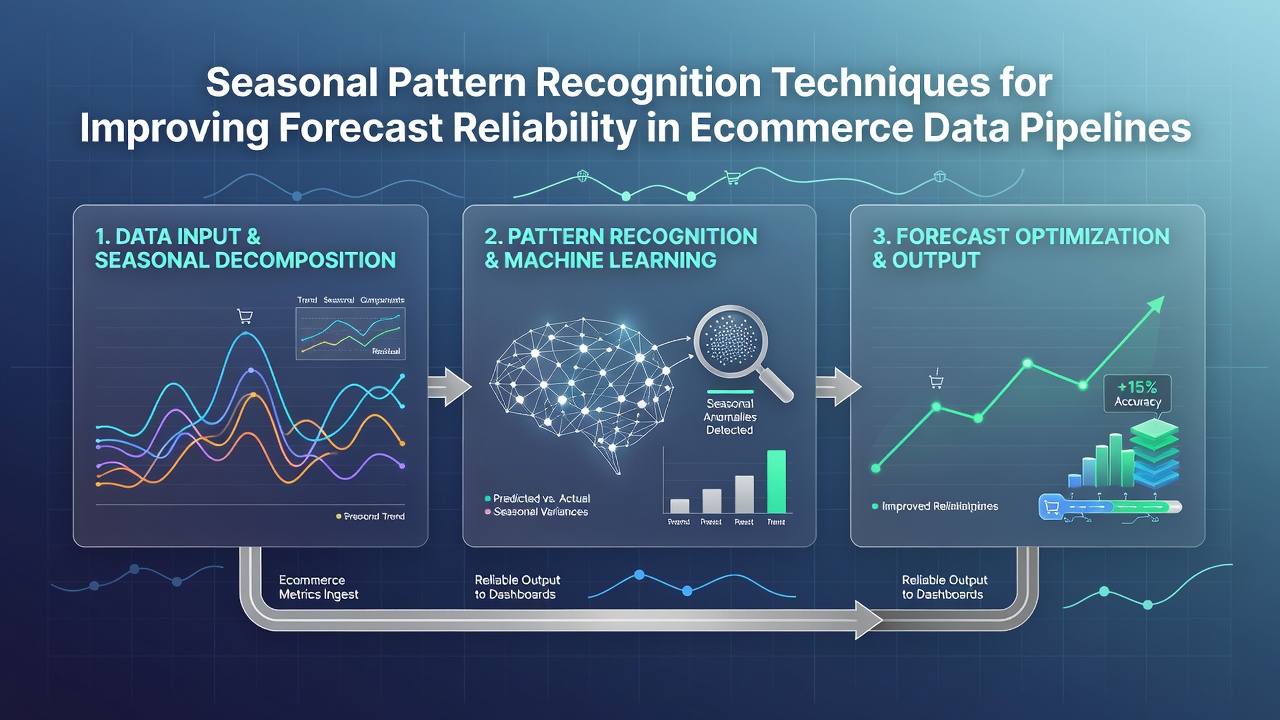
Seasonal patterns in ecommerce data emerge from recurring cycles tied to holidays, weather shifts, and consumer behavior trends that repeat across months or years, and researchers apply specialized recognition techniques to extract these signals from noisy transaction streams before they feed into forecasting models. Data pipelines in ecommerce environments collect real-time sales, inventory, and traffic metrics from multiple sources, yet without pattern detection layers the forecasts lose accuracy during peak periods such as back-to-school promotions or end-of-year events. Observers note that incorporating seasonal decomposition methods early in the pipeline allows downstream models to adjust baselines dynamically rather than treating every spike as an anomaly.
Core Components of Seasonal Pattern Detection
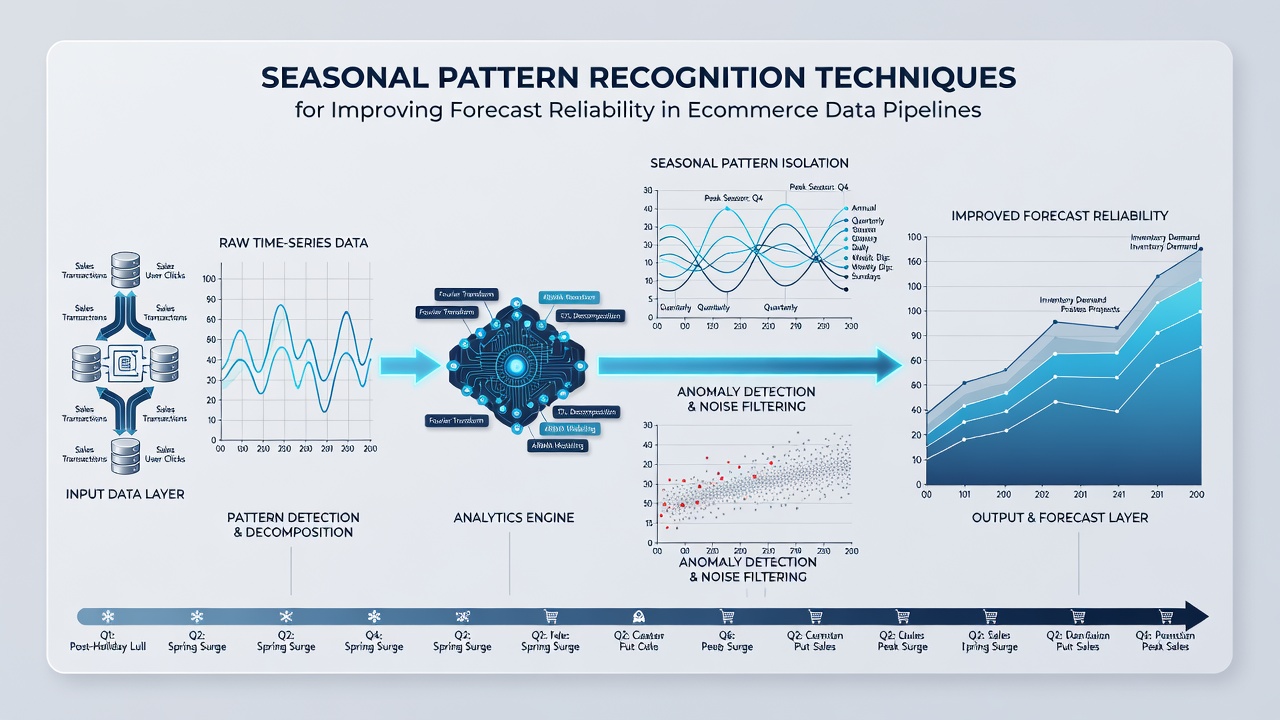
Time series decomposition separates observed values into trend, seasonal, and residual elements, and practitioners implement this step using algorithms like STL or X-13ARIMA-SEATS that handle multiple seasonalities simultaneously when daily, weekly, and annual cycles overlap in the same dataset. Fourier analysis identifies dominant frequencies within historical sales records, which helps data engineers flag recurring intervals without manual calendar mapping, while machine learning approaches such as seasonal ARIMA variants or Prophet models integrate these frequencies as regressors to improve multi-step ahead predictions. Studies from government statistical agencies show that pipelines equipped with these components reduce mean absolute percentage error by measurable margins during known seasonal windows compared with baseline models that ignore periodicity.
Integration into Ecommerce Data Pipelines
Pipeline architectures typically route raw event logs through extraction layers before seasonal recognition modules process the aggregated series at hourly or daily granularity, and engineers embed these modules as modular services that output adjusted features for subsequent forecasting stages. Real-time adjustments become possible when pattern recognition runs on streaming platforms that update seasonal indices continuously, allowing models to recalibrate as new October 2026 transaction data arrives ahead of holiday surges. Data from the US Census Bureau illustrates how retail sales exhibit strong November and December lifts each year, and pipelines that ingest these official seasonal factors alongside proprietary logs achieve tighter confidence intervals around projected inventory needs.
Advanced Recognition Methods and Their Applications
Ensemble techniques combine outputs from multiple seasonal detectors, including clustering algorithms that group similar product categories by shared periodicity signatures, and this approach proves useful when product portfolios span both perennial staples and highly seasonal categories such as swimwear or electronics. Neural network architectures with attention mechanisms learn to weigh recent seasonal analogs more heavily, and training occurs on multi-year datasets that capture at least three full cycles to avoid overfitting to single events. Research published by Australian Bureau of Statistics demonstrates that seasonal adjustment frameworks applied to online retail series improve forecast reliability across different economic conditions, and ecommerce operators adapt similar frameworks to their internal pipelines for comparable gains.
Feature engineering pipelines generate lagged seasonal variables and holiday proximity indicators that feed directly into gradient boosting or recurrent neural models, while cross-validation schemes respect temporal ordering to prevent leakage of future seasonal information into training folds. Those who maintain these systems monitor drift in seasonal amplitudes, because shifts in consumer timing, such as earlier holiday shopping observed in recent years, require periodic recalibration of recognition parameters to keep forecasts aligned with current behavior.
Handling Edge Cases in Seasonal Data
Irregular events like global disruptions or platform outages can mask or distort seasonal signals, and robust pipelines incorporate outlier detection that flags deviations before they contaminate seasonal index calculations. Multiple seasonality handling becomes critical for marketplaces operating across regions with differing holiday calendars, and vector-based approaches or hierarchical forecasting structures reconcile forecasts at both aggregate and granular levels. Evidence from industry reports indicates that pipelines equipped with these safeguards maintain stable performance even when one regional market experiences atypical demand patterns that would otherwise propagate errors upward.
Conclusion
Seasonal pattern recognition techniques strengthen forecast reliability by embedding periodicity awareness throughout ecommerce data pipelines, from initial ingestion through model output generation, and continued refinement of these methods supports more precise inventory, staffing, and marketing decisions as transaction volumes grow. As October 2026 approaches, organizations that update their seasonal components with the latest cycle data position their forecasting systems to capture expected demand variations without relying on static assumptions.